
California School Zone Pedestrian Accidents in 2026: New Safety Laws and Injury Claims
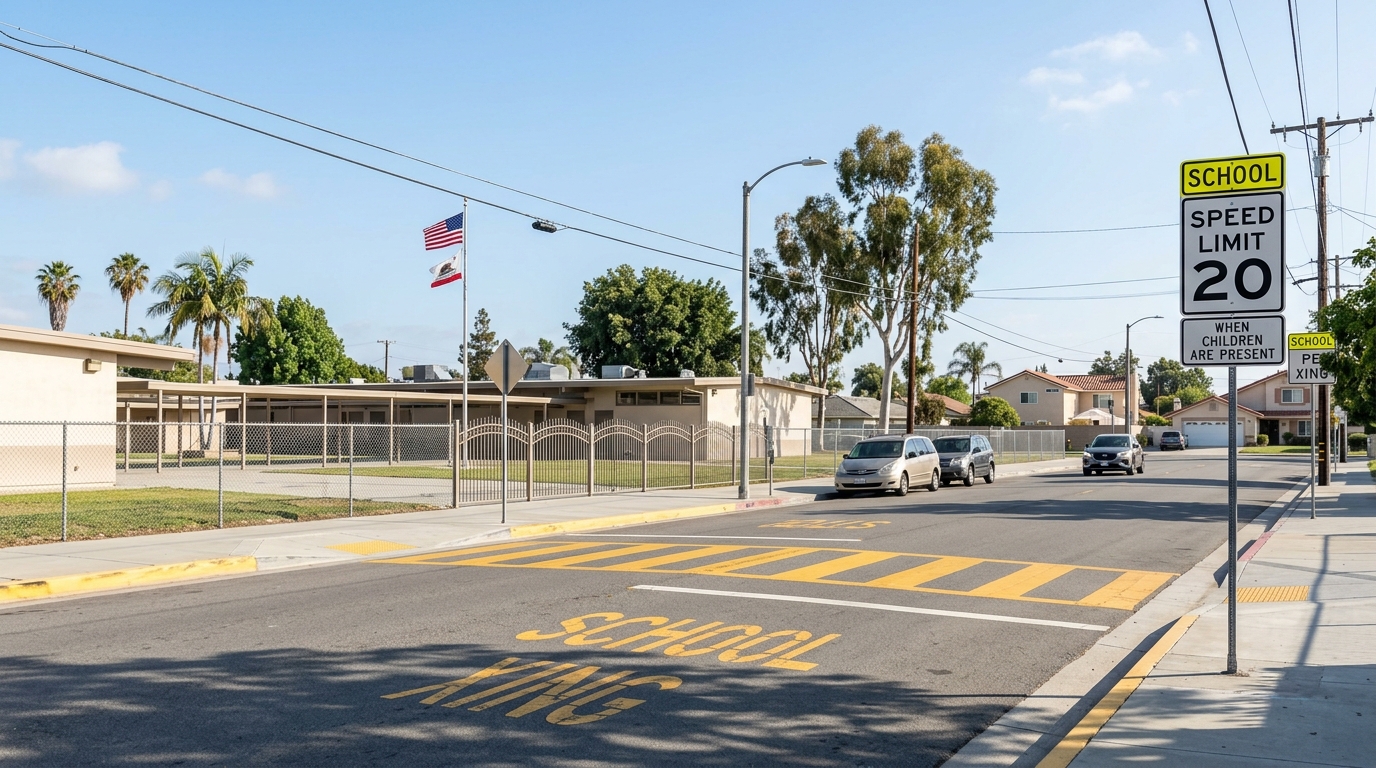
In 2026, California introduced additional opportunities for communities to reduce vehicle speeds near schools. Assembly Bill 382 allows local governments to establish a 20 mph school-zone speed limit through an ordinance or resolution.
However, the law does not mean that every California school zone automatically has a 20 mph limit in 2026. Drivers must follow the applicable posted limits and traffic rules.
Understanding these changes is valuable for pedestrian safety and personal injury claims. When collisions occur, injured individuals may need to evaluate driver negligence, medical expenses, insurance coverage, and legal deadlines.
This guide explains California’s updated school-zone rules, common accident causes, liability questions, and possible compensation after a pedestrian injury.
California School Zone Pedestrian Accidents and New 2026 Safety Laws
School zones require special attention because children may behave unpredictably around roads. They may cross unexpectedly, walk between parked vehicles, or become distracted while approaching school entrances.
Drivers must remain attentive, respond to traffic conditions, and follow applicable safety requirements. Reduced speeds can give motorists more time to react when pedestrians enter the roadway.
California’s 2026 legislative changes provide additional tools for improving safety near schools. Nevertheless, determining which speed limit applies requires checking local regulations and posted signs.
Understanding California’s New 20 MPH School Zone Law
Assembly Bill 382 introduced changes to California’s school-zone speed regulations. Beginning January 1, 2026, local authorities may establish a 20 mph prima facie speed limit within qualifying school zones by adopting an ordinance or resolution.
The measure gives communities flexibility to respond to local pedestrian risks. However, cities and counties must follow the relevant statutory procedures.
For example, a municipality may determine that a busy school entrance would benefit from a lower speed limit. Officials can then evaluate applicable road conditions and adopt appropriate regulations.
How Assembly Bill 382 Affects Drivers
Drivers should understand that a 20 mph school-zone speed limit is not automatically applicable everywhere in California during 2026.
Instead, local adoption and the applicable road signs determine whether the reduced limit applies at a particular location.
As a result, motorists should actively watch for school-zone signs rather than assuming that every school has identical speed requirements.
Additionally, California law requires motorists to operate at a safe speed for actual conditions, even when driving below a posted speed limit.
Traffic congestion, poor visibility, pedestrians, and children entering crosswalks may require additional caution.
Therefore, following a posted speed limit does not automatically excuse a driver from responsibility when unsafe driving causes an accident.
Why Lower Speeds Matter for Pedestrian Safety
Vehicle speed can significantly influence a driver’s ability to recognize hazards and avoid collisions.
When traveling faster, vehicles generally require greater distances to stop. Higher impact speeds may also increase the severity of pedestrian injuries.
Consequently, reducing speeds around schools can improve the opportunity for drivers to respond when children cross unexpectedly.
However, speed limits represent only one component of pedestrian safety. Well-marked crosswalks, clear visibility, safe sidewalks, and appropriate traffic controls also matter.
Parents and guardians can help by teaching children to use designated crossings, observe traffic signals, and avoid distractions near roadways.
Similarly, schools and communities can evaluate dangerous intersections and report concerns to local transportation officials.
These efforts may reduce preventable collisions, although no single safety measure eliminates every risk.
Who Is Liable for a School Zone Pedestrian Accident?
Determining responsibility after a pedestrian collision requires examining the conduct of everyone involved.
California negligence law generally considers whether a person owed a duty of reasonable care, breached that duty, and caused legally recognized injuries.
A driver may be responsible when careless conduct causes a pedestrian accident. Nevertheless, fault should be established through evidence rather than assumptions.
Common Driver Behaviors That Cause Pedestrian Injuries
Several driving behaviors can create dangerous situations near schools.
- Speeding: Traveling above the applicable limit or too fast for existing conditions.
- Distracted driving: Looking at phones, navigation systems, or other distractions.
- Failure to yield: Disregarding pedestrian right-of-way requirements at applicable crossings.
- Unsafe turning: Turning without adequately checking for pedestrians.
- Improper stopping: Blocking visibility near designated crossings.
- Impaired driving: Operating a vehicle while affected by alcohol or drugs.
For example, a motorist approaching a marked school crosswalk may fail to notice a child entering the roadway because the driver is distracted.
If that negligent conduct causes an injury, the injured person may have grounds to pursue compensation.
However, investigators must still evaluate vehicle movements, traffic signals, witness accounts, and other relevant evidence.
Learn more about negligence and evidence in our guide to car accident injury claims.
Comparative Negligence and Shared Responsibility
California generally follows a pure comparative negligence system. Under this approach, a person’s recoverable damages may be reduced according to their share of responsibility.
For example, an adult pedestrian who unexpectedly enters traffic may be found partly responsible for a collision, depending on the circumstances.
Nevertheless, a pedestrian’s possible mistake does not automatically eliminate their claim.
Cases involving children require additional consideration because a child’s conduct is not necessarily evaluated using the same expectations applied to an adult.
A child’s age, experience, and capacity may be relevant when assessing reasonable care.
Therefore, families should avoid assuming that a pedestrian collision is automatically the driver’s fault or that a child can never be assigned responsibility.
Each case requires an individualized analysis of the facts and applicable legal standards.
Personal Injury Claims After California School Zone Pedestrian Accidents
School-zone collisions may result in injuries requiring extensive treatment and rehabilitation.
Because pedestrians lack the physical protection provided by a vehicle, even a relatively low-speed collision can cause serious harm.
Possible injuries include fractures, traumatic brain injuries, spinal injuries, soft tissue damage, and psychological distress.
The severity of these injuries depends on multiple factors, including vehicle speed, impact location, medical history, and the circumstances of the collision.
How Injured Pedestrians Can Protect Their Legal Rights
Taking practical steps after an accident can help preserve important evidence and support an injury claim.
First, obtain appropriate medical attention. A professional evaluation can identify injuries and establish records of symptoms, diagnoses, and recommended treatment.
Second, report the incident to the appropriate authorities. When police investigate, obtain information needed to request the accident report.
Third, preserve photographs of the intersection, roadway markings, school-zone signs, vehicle damage, and visible injuries.
Fourth, collect witness contact details whenever it is safe and practical.
Finally, maintain records of medical bills, missed work, transportation expenses, and communications with insurance companies.
These records may become particularly important when fault or the severity of injuries is disputed.
For a broader explanation of resolving claims, read our article about understanding personal injury settlements.
What compensation may be available?
California pedestrian injury claims may involve both economic and noneconomic damages.
Economic damages represent measurable financial losses. Depending on the evidence, these may include emergency medical expenses, rehabilitation costs, future treatment, lost wages, and reduced earning capacity.
Noneconomic damages may address physical pain, emotional distress, and loss of enjoyment of life when legally recoverable.
However, a settlement amount is not determined by medical bills alone.
Claim value may also depend on liability, injury severity, future care needs, insurance coverage, and legally applicable restrictions.
Furthermore, insurance limits can affect the amount available from a particular policy without necessarily establishing the total value of the damages.
Families should review settlement terms carefully, particularly when injuries involve ongoing treatment or long-term limitations.
Can parents file an injury claim for their child?
When a minor is injured, a parent or another legally authorized representative may pursue a claim on the child’s behalf.
However, settlements involving minors can require additional procedures and court approval under California law.
This oversight helps protect the child’s financial interests and ensures appropriate consideration of the proposed resolution.
Families should also distinguish between the injured child’s claims and any separate claims that a parent may legally possess.
Because these procedures can be complex, professional legal guidance may help prevent mistakes when resolving a minor’s injury case.
What if a school or government agency contributed to the accident?
Some pedestrian accidents involve allegations of dangerous road conditions, inadequate traffic controls, or other hazards associated with public property.
Under certain circumstances, a public entity may face liability for a dangerous condition of public property.
However, liability is not automatic. Statutory requirements, notice rules, immunity provisions, and evidence of the alleged hazard can affect the case.
Moreover, California Government Claims Act procedures often require a personal injury claim against a public entity to be presented within six months, subject to applicable exceptions.
Therefore, injured people should not assume that the standard personal injury lawsuit deadline applies without additional requirements.
How long do pedestrians have to file a lawsuit?
California Code of Civil Procedure Section 335.1 generally establishes a two-year limitations period for many personal injury lawsuits.
Nevertheless, cases involving minors, public entities, and other special circumstances may follow different rules.
Importantly, the existence of a longer limitations period for some claims does not necessarily eliminate shorter administrative claim deadlines.
Readers can explore these distinctions in our personal injury statute of limitations guide.
Frequently asked questions
Is every California school zone limited to 20 mph in 2026?
No. AB 382 allows local authorities to establish qualifying 20 mph school-zone limits, but the change is not automatically universal in 2026.
Can someone recover compensation if a driver was not speeding?
Potentially. A driver can be negligent through other unsafe actions, including distraction, failure to yield, or unreasonable driving for existing conditions.
Can a child receive compensation after a pedestrian accident?
Yes, when a legally valid claim is established. Special rules may govern claims and settlements involving minors.
Do pedestrian injury claims always require a trial?
No. Some claims are resolved through negotiated settlements. However, litigation may become necessary when important disputes remain unresolved.
Final thoughts
California school zone pedestrian accidents in 2026 highlight the importance of safer driving, effective traffic controls, and awareness of changing regulations.
Assembly Bill 382 provides local governments with another opportunity to reduce school-zone speeds. Still, accident liability depends on the circumstances rather than the existence of a speed-limit rule alone.
By seeking medical care, preserving evidence, and understanding legal deadlines, injured pedestrians and families can make more informed decisions about their potential claims.
For authoritative information about the new law, review the California Highway Patrol’s 2026 public safety laws announcement.
Disclaimer: This article provides general educational information about California law as of October 2026. It is not individualized legal advice.